

In the vast and transformative world of yoga, mental discipline holds as much importance as physical movement. While most practitioners begin with asanas and breathwork, the true journey inward begins when the mind is trained to focus and remain still. This is where Dharana and Dhyana, two essential limbs of Patanjali’s Eightfold Path, play a major role.
Although these two concepts are closely related, they represent significantly different stages of inner awareness. For anyone curious about deeper yoga, meditation, or spiritual growth, understanding Dharana vs Dhyana is the key to unlocking genuine mental clarity.
This article explains their differences, benefits, techniques, and practical applications with deeper emphasis on Dharana. It includes what is Dharana in yoga, Dharana yoga definition, Dharana yoga steps, Dharana yoga pose, types of Dharana in yoga, and Dharana yoga for beginners.
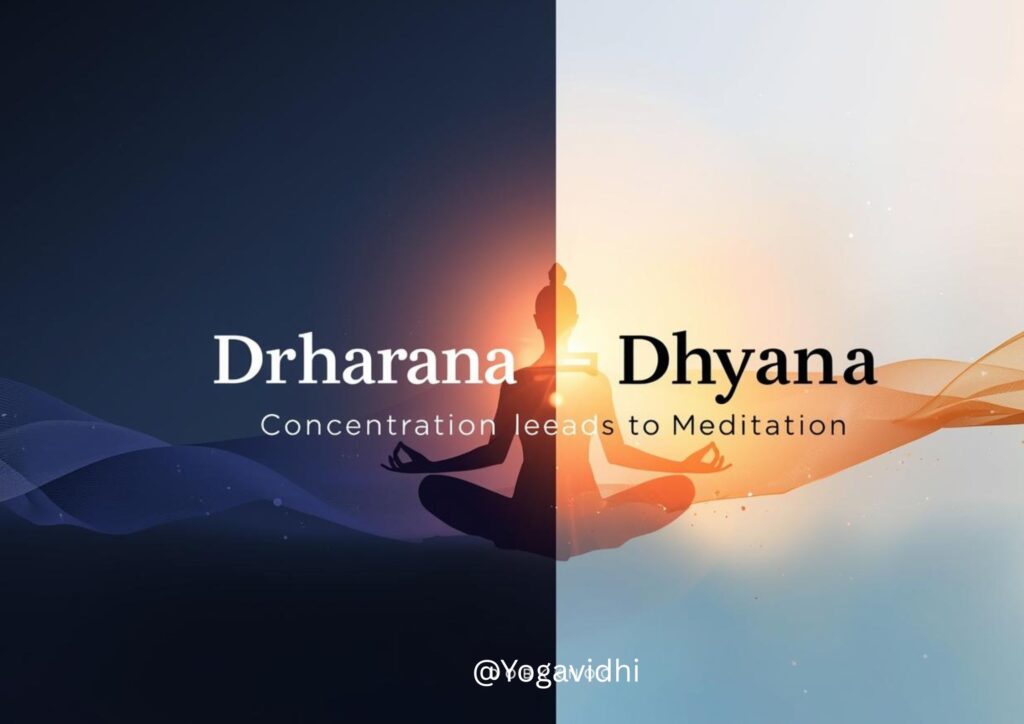
Dharana is the deliberate effort to focus the mind on a single object, while Dhyana is the smooth, effortless state of remaining absorbed in that focus. In Dharana, the mind must be guided back whenever it wanders, but in Dhyana, it naturally stays still and centered, creating a deeper experience of meditation.
Table of Contents
Introduction: Why Dharana and Dhyana Matter in Yoga
Yoga is more than physical postures. It is a philosophy and practice that leads individuals to inner awareness. In Patanjali’s Yoga Sutras, the path to enlightenment is described through the Eight Limbs of Yoga where:
- Dharana is the 6th limb (concentration)
- Dhyana is the 7th limb (meditation)
Understanding this sequence is essential. Dharana naturally leads to Dhyana. Concentration leads to meditation. Effort leads to effortlessness.
For beginners and advanced practitioners alike, mastering Dharana transforms the mind and deepens every aspect of spiritual practice.
What Is Dharana in Yoga
To understand Dharana vs Dhyana, we must first answer a simple question: what is Dharana in yoga?
Dharana is the yogic practice of single pointed concentration. It is where the mind learns to remain focused deliberately without drifting into distraction.
Dharana Yoga Definition
Dharana yoga is the discipline of training the mind to stay anchored to one point of attention, one thought, or one object. This stage is intentional, effort driven, and prepares the mind for meditation.
During Dharana, you are actively choosing where to direct your awareness.
Common Dharana focus points include:
- the breath
- a mantra
- a candle flame
- the heart center
- an image or symbol
- a sound such as Om
This is the foundation of inner mental mastery.
What Is Dhyana
While Dharana requires effort, Dhyana is the state where concentration becomes seamless. Dhyana is meditation in its purest form. It is continuous, uninterrupted awareness that flows naturally.
Characteristics of Dhyana:
- The mind becomes calm without force
- Thoughts slow down on their own
- Awareness expands beyond a single object
- You shift from doing to observing
- A deep sense of peace arises
In simple words:
Dharana is holding the mind still.
Dhyana is the mind becoming still by itself.
Dharana vs Dhyana: Key Differences
| Aspect | Dharana | Dhyana |
| Nature | Concentration | Meditation |
| Effort | Requires effort | Effortless |
| Focus | On one object | Expanded awareness |
| State of mind | Controlled | Naturally still |
| Purpose | Preparation | Transformation |
These differences show why Dharana must be mastered before entering Dhyana. Without concentration, meditation becomes difficult and unstable.
Read More: Self-Love Yoga: Embrace Your True Self Through Movement, Breath & Mindfulness
Read More: Samadhi in Yoga: The Ultimate State of Consciousness Backed by Science and Deep Mind-Body Harmony
Types of Dharana in Yoga
There are several types of Dharana in yoga based on the chosen object of focus. Some traditional and modern forms include:
1. Breath Focused Dharana (Anapanasati)
Ideal for beginners. The breath becomes the anchor for concentration.
2. Mantra Dharana
Repeating a sacred sound or phrase to steady the mind.
3. Trataka Dharana (Candle Gazing)
Fixing the eyes and mind on a candle flame to enhance focus.
4. Visualization Dharana
Holding a mental image such as a chakra, deity symbol, color, or geometry.
5. External Object Dharana
Using objects like flowers, pictures, statues, or mandalas.
6. Body Point Dharana
Concentrating on sensations or points such as the heart or third eye.
These practices allow every personality type to find a suitable method of concentration.
Dharana Yoga Benefits
The benefits of Dharana extend far beyond meditation. Here are some powerful Dharana yoga benefits:
1. Sharper Concentration
Your ability to stay focused increases significantly.
2. Reduced Stress and Anxiety
Mental chatter fades as the mind learns to stay still.
3. Stronger Mental Discipline
You gain better control over emotions and reactions.
4. Enhanced Creativity and Insight
With clarity comes deeper understanding and fresh ideas.
5. Preparation for Dhyana
Dharana creates the mental foundation needed for effortless meditation.
6. Improved Productivity
A focused mind is far more efficient in everyday tasks.
Dharana strengthens the mind just as exercise strengthens the body.
Dharana Yoga Pose
A Dharana yoga pose is any posture that supports stillness and concentration. The most useful ones include:
1. Padmasana (Lotus Pose)
A stable seat ideal for long concentration sessions.
2. Sukhasana (Easy Pose)
A comfortable option for Dharana yoga for beginners.
3. Vajrasana (Thunderbolt Pose)
Supports a straight spine and alertness.
4. Siddhasana (Accomplished Pose)
Encourages balance and stillness for Dharana practice.
These poses make concentration easier by keeping the body calm and steady.
How to Practice Dharana Yoga: Step by Step
Here is a clear guide on how to practice Dharana yoga effectively.
Dharana Yoga Steps
Step 1: Find a Quiet Space
Choose an environment that supports stillness.
Step 2: Select Your Object of Focus
Choose something simple and natural such as breath, mantra, or a candle flame.
Step 3: Sit in a Dharana Yoga Pose
Maintain a straight spine and relaxed body.
Step 4: Bring Your Mind Back Each Time It Wanders
Do this gently without criticism or frustration.
Step 5: Stay With Your Chosen Point of Awareness
Begin with 5 to 15 minutes of single point concentration.
Step 6: Increase Duration Gradually
Over time build your concentration to longer sessions.
These steps show exactly how to practice Dharana yoga in a simple and practical way.
How Dharana Leads to Dhyana
One of the most important aspects of Dharana vs Dhyana is understanding their relationship.
Dharana becomes Dhyana when concentration continues without interruption.
In Dharana you are still putting in effort to focus.
In Dhyana focus flows naturally without force.
Dharana is essential before Dhyana because it prepares the mind for effortless awareness.
How to Practice Dhyana After Dharana
Once Dharana becomes stable, you can transition into Dhyana.
1. Reduce Your Effort
Stop controlling the mind.
2. Observe Instead of Direct
Let thoughts come and go without reaction.
3. Allow Awareness to Expand
No need to hold onto the object of focus.
4. Enter Deep Stillness
Meditation unfolds naturally.
This state brings profound peace and connection.
Common Mistakes to Avoid in Dharana and Dhyana
- Forcing the mind too strongly
- Changing focus objects too often
- Expecting instant results
- Practicing inconsistently
- Confusing relaxation with meditation
Patience and consistency are essential.
Dharana Yoga for Beginners: Helpful Tips
If you are starting your practice, here are simple ways to master Dharana:
- Begin with short daily sessions
- Choose the breath as your main focus
- Keep the body still during practice
- Use the same place and time daily
- Be gentle when the mind wanders
- Avoid multitasking throughout the day
These habits build the foundation needed for both concentration and meditation.
Conclusion: Dharana vs Dhyana
Dharana and Dhyana are two essential stages of inner growth. Dharana trains the mind to focus. Dhyana allows the mind to rest in effortless awareness.
If you want deeper meditation, emotional stability, mental clarity, and real spiritual progress, begin with Dharana yoga. Its benefits support beginners and advanced practitioners alike.
Master Dharana and Dhyana will naturally follow.
Frequently Asked Questions (FAQ):
Q. What is Dharana in yoga?
Ans: Dharana in yoga is the practice of single pointed concentration. It involves focusing the mind on one object such as the breath, a mantra, or a candle flame. Dharana prepares the mind for deeper meditation.
Q. What is the difference between Dharana and Dhyana?
Ans: Dharana is concentration that requires effort, while Dhyana is effortless meditation. In Dharana you focus intentionally. In Dhyana the mind becomes naturally still and awareness flows continuously.
Q. How can beginners practice Dharana effectively?
Ans: Beginners can start Dharana by choosing a quiet place, sitting in a stable posture, focusing on the breath or a simple object, and gently bringing the mind back each time it wanders. Starting with 5 to 10 minutes daily is ideal.
Q. What are the main types of Dharana in yoga?
Ans: The main types of Dharana include breath focused concentration, mantra repetition, candle gazing (Trataka), visualization, focusing on an external object, and body point concentration such as the heart or third eye.
Q. What are the benefits of practicing Dharana yoga regularly?
Ans: Regular Dharana practice improves focus, reduces stress, sharpens mental clarity, boosts creativity, enhances emotional balance, and prepares the mind for deep meditation or Dhyana.
Declaration Note:
We use third-party videos and images on https://yogavidhi.com/ for educational and illustrative purposes. All rights belong to their respective owners. No copyright infringement is intended.



As I web site possessor I believe the content material here is rattling wonderful , appreciate it for your efforts. You should keep it up forever! Best of luck.
Thank you so much for your kind and encouraging words! I truly appreciate you taking the time to share your feedback. Your support motivates me to keep creating valuable and meaningful content. I’m grateful to have readers like you and will definitely continue striving to do our best. Best wishes to you as well, and thanks again for the positivity!