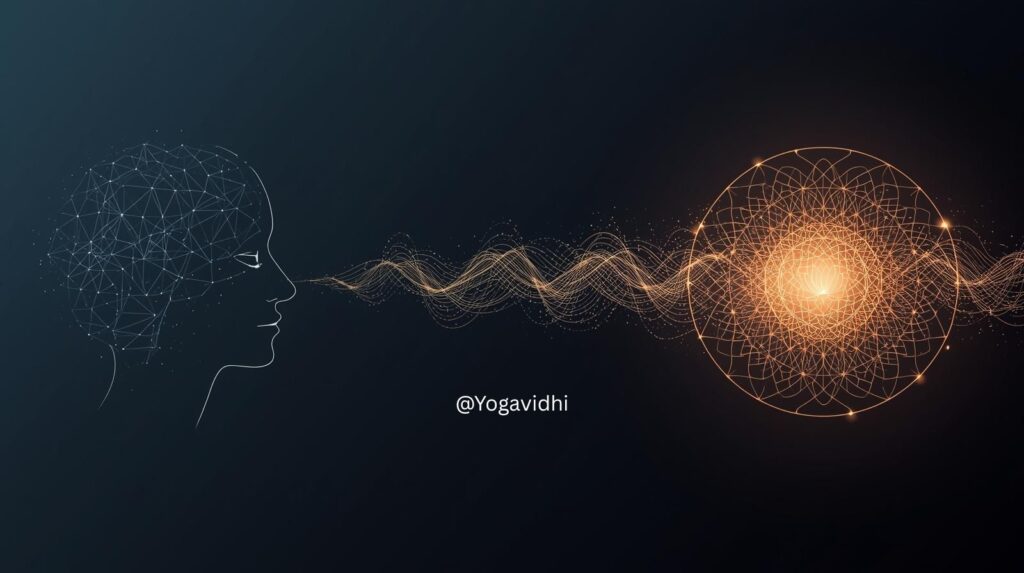

In the journey of yoga, the path does not end with physical postures or mindful breathing. The ultimate destination of yoga is Samadhi, a profound state where consciousness becomes expansive, the mind becomes silent, and a person experiences complete inner freedom. When people search Samadhi in yoga, what they want to know is: What exactly is Samadhi? Is it achievable in real life? And what science says about this highest state of awareness?
In modern times, where stress, anxiety, and distractions constantly steal our peace, the relevance of Samadhi has become even stronger. It is the eighth limb of Patanjali’s Ashtanga Yoga – the peak of meditation and inner transformation. While it may sound mystical or spiritual, Samadhi is also deeply connected with neuroscience, psychology, and mental health.
This article explores Samadhi in yoga from both a classical and scientific perspective – breaking down the concept in simple language while showing how it can improve your brain, emotional health, and overall well-being.
Samadhi is the eighth and ultimate limb of yoga, symbolizing a deep state of meditative absorption in which the individual self unites with the universal consciousness. It is often referred to as a state of liberation, pure bliss, or enlightenment, where the mind becomes completely still and free from all mental distractions and ego-driven thoughts. Reached through consistent practice of the previous seven limbs of yoga, Samadhi represents a profound, non-dualistic union between the meditator, the focus of meditation, and the infinite universal energy.
Table of Contents
What is Samadhi in Yoga? A Scientifically Relevant Understanding
Samadhi in yoga refers to a state of pure awareness where the mind becomes one-pointed, calm, and completely free from mental fluctuations. It is often described as:
“The merging of the individual self with the universal consciousness.”
But scientifically, Samadhi can be interpreted as:
- A state of non-dual awareness
- A shift from the thinking brain to the being brain
- A deep flow state where the ego dissolves
- A mind functioning without overthinking or emotional turbulence
In Samadhi meditation, the practitioner experiences:
1. Heightened focus
2. Deep peace
3. Loss of time, space, and identity
4. A blissful sense of oneness
Modern researchers compare Samadhi-like states with advanced meditation levels seen in long-term monks whose brains show:
- Reduced activity in the Default Mode Network (DMN) – the area responsible for stress, worry, and self-talk
- Increased coherence in brain waves – especially gamma waves, which indicate cognitive excellence and clarity
This suggests that Samadhi in yoga is not supernatural – it is a measurable shift in consciousness.
Samadhi vs. Meditation: What’s the Difference?
A common misconception is that Samadhi is meditation. But in yogic science:
Dhyana (Meditation) = Deep uninterrupted concentration
Samadhi = When even effort disappears
Meditation involves trying to focus.
Samadhi is a state where focus becomes effortless.
It is like:
- Meditation is climbing a mountain.
- Samadhi is reaching the peak and enjoying the view.
The Science and Philosophy Behind Samadhi
Traditional yoga says Samadhi takes place when:
- The mind is fully purified
- The breath becomes subtle
- The practitioner achieves mastery over awareness
From a scientific lens, Samadhi reflects:
- Regulation of the autonomic nervous system
- Activation of parasympathetic dominance – deep healing
- Reduction in cortisol – lower stress
- Enhanced hippocampal activity – better emotional control
A 2014 Harvard study on deep meditators found:
- Brain aging was slower
- Anxiety, depression symptoms reduced
- Compassion levels increased
Samadhi in yoga brings permanent neuroplastic changes that reshape mental and emotional health.
Types of Samadhi: Samprajnata & Asamprajnata
Yoga categorizes Samadhi into two major types:
1️. Samprajnata Samadhi (Savikalpa/Conscious Samadhi)
Where awareness still exists but is completely stabilized.
It has four stages:
- Vitarka: Focus on a subtle or gross object
- Vichara: Analytical awareness dissolves
- Ananda: Bliss arises from deep concentration
- Asmita: Identity reduces to pure existence
This stage is still connected to the mind and self-awareness.
Scientifically:
Gamma brainwave patterns are elevated during this state – linked to high cognitive functioning.
2️. Asamprajnata Samadhi (Nirvikalpa/Superconscious Samadhi)
Where even the sense of “I” disappears completely.
No thoughts.
No ego.
Only pure consciousness.
Researchers associate this with:
- Non-dual awareness
- Complete DMN deactivation
- A feeling of universal connectedness
This is considered the highest state of yoga – spiritual liberation from suffering.
Can Samadhi Be Achieved in Modern Life? – Yes. Here’s How.
Yoga is clear: Samadhi is not only for monks living in caves.
Anyone with consistent practice can reach higher states of awareness.
Here’s the yogic process leading to Samadhi:
Yama & Niyama – Mental and ethical discipline
Asana – Preparing the body
Pranayama – Mastering the breath
Pratyahara – Withdrawing senses from distractions
Dharana – Concentration
Dhyana – Deep meditation
Samadhi – Complete absorption
Modern actions that support Samadhi:
- Digital detox
- Breathwork and mindfulness practices
- Nature immersion
- Emotional regulation techniques
- Therapy and self-development
- Neuroscience-backed meditation
Achieving Samadhi isn’t about religion. It’s about training the mind to be present and free from chaos.
| Feature | Samprajnata Samadhi (Savikalpa / Conscious Samadhi) | Asamprajnata Samadhi (Nirvikalpa / Superconscious Samadhi) |
| Meaning | Samadhi with awareness of subtle thoughts | Samadhi beyond thoughts and identity |
| Connection to Mind | Still connected to the subconscious mind | Mind completely transcended |
| Awareness State | Focused awareness continues | Only pure consciousness remains |
| Sense of “I” | Reduced but still present | Ego dissolves entirely |
| Experience | Bliss, peace, deep clarity | Infinite oneness and complete liberation |
| Brain Function (Scientific View) | Higher gamma wave activity; DMN partially reduced | Default Mode Network (DMN) almost fully deactivated |
| Progression | Intermediate level of Samadhi | Final and highest level of Samadhi |
| Accessibility for Practitioners | Achievable with disciplined meditation | Requires advanced spiritual mastery |
| Result | Temporary state of deep unity | Permanent transformation and spiritual freedom |
Benefits of Samadhi: What Happens When Consciousness Expands?
Samadhi in yoga offers unmatched transformation:
Mental & Cognitive Benefits
- Higher intelligence & creativity
- Sharper memory and problem-solving
- Emotional resilience and clarity
- Reduced anxiety and rumination
Psychological Benefits
- Freedom from overthinking
- Better self-control and discipline
- Stronger intuition
- Sense of inner fulfillment
Emotional & Interpersonal Benefits
- Increased compassion and empathy
- Healthy detachment from negativity
- Improved relationships and communication
Physical Health Benefits
- Better nervous system regulation
- Lower stress hormones
- Improved sleep quality
- Enhanced energy and longevity
Science supports that Samadhi-like states can reverse the impact of stress and align the body’s healing mechanisms.
Signs You Are Moving Toward Samadhi
You may be closer to Samadhi than you think if you notice:
- Greater awareness of thoughts and emotions
- Less attachment to drama or material validation
- Moments of stillness and inner silence
- Joy without external triggers
- Heightened mindfulness in daily actions
The more you observe life instead of reacting to it, the closer you are to Samadhi.
Challenges on the Path (And How to Overcome Them)
The mind often resists silence.
Common obstacles:
- Restlessness and boredom
- Ego-driven expectations
- Inconsistent discipline
- Emotional triggers
Solutions:
- Practice daily even 10 minutes helps
- Focus on progress, not perfection
- Choose guided Samadhi meditation techniques
- Be patient big changes take time
Samadhi in yoga doesn’t demand isolation, only commitment.
Scientific View: Who Can Reach Samadhi?
Brain studies show everyone has the potential to access higher consciousness, regardless of:
- Age
- Background
- Religion
- Lifestyle
You do not need to abandon your responsibilities.
You just need to train your brain like a muscle – with mindfulness.
Even busy professionals have experienced profound transformation through meditation retreats and breathwork practices.
Samadhi in Modern Life: Practical Application
Samadhi isn’t just a spiritual trophy – it is a practical wellness tool that improves daily living:
- You handle challenges calmly
- You become more present and productive
- Relationships become peaceful
- Success becomes effortless because the mind supports you instead of sabotaging you
Samadhi in yoga gives your life direction, depth, and emotional strength.
Read More: Sivananda Yoga: A Holistic Path to Inner Peace, Health & Self-Realization
Read More: Yoga for Diabetes: Natural Poses, Breathing Techniques, and Lifestyle Tips to Balance Blood Sugar
Conclusion: Samadhi – The Future of Mental and Spiritual Evolution
Samadhi in yoga is not just the final limb of the yogic path – it is the ultimate human potential.
In a world full of noise, pressure, and confusion, Samadhi teaches us how to live with clarity and peace from within.
It is the science of:
- mastering the mind
- unlocking inner happiness
- transcending stress and suffering
Whether you’re a spiritual seeker or someone who wants better mental health, Samadhi meditation can guide you toward a healthier, more conscious, and more fulfilling life.
Yoga invites you to experience this state not by escaping life, but by becoming fully aware of it.
Samadhi is not the end of the journey, it is the beginning of true freedom.
Frequently Asked Questions About Samadhi in Yoga:
Q. How long does it take to achieve Samadhi?
Ans: It varies. Some achieve glimpses within months; others take years. Consistency matters more than speed.
Q. Is Samadhi similar to enlightenment?
Ans: It is a major step toward enlightenment the highest transformation of consciousness.
Q. Can Samadhi be explained scientifically?
Ans: Yes. It aligns with measurable changes in brain activity and emotional regulation.
Q. Do you lose awareness in Samadhi?
Ans: No, awareness becomes more intense, but without distraction or ego.
Q. Can beginners try Samadhi meditation?
Ans: Absolutely! The journey starts with mindfulness and progresses gradually to deeper states
Q. What is the process of samadhi?
Ans: According to Diener, Erhard, and Fischer-Schreiber, samādhi is a state of non-dual consciousness where the awareness of the individual merges completely with the object of observation. Swami Sivananda explains that when the mind becomes fully immersed in a single point of focus during meditation, this state is known as Samadhi.
Declaration Note:
We use third-party videos and images on https://yogavidhi.com/ for educational and illustrative purposes. All rights belong to their respective owners. No copyright infringement is intended.