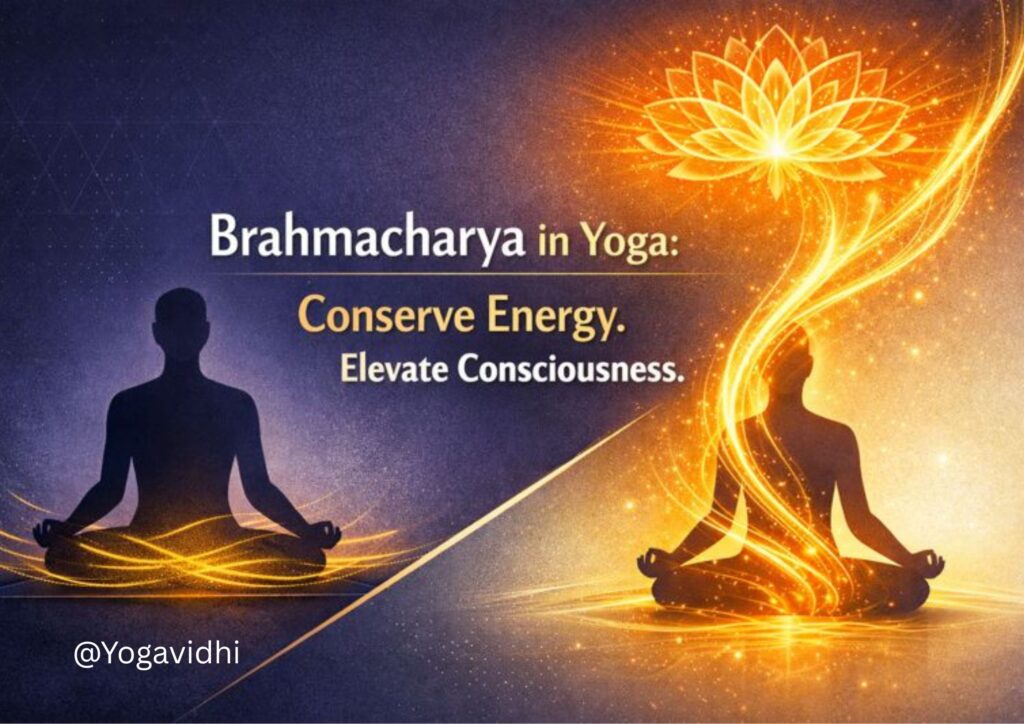

Yoga for Brahmacharya centers on preserving and transforming vital energy (prana) to support spiritual growth. It emphasizes moderation, self-restraint, and conscious living, supported by specific asanas, bandhas, and pranayama practices such as Siddhasana, Mula Bandha, and Bhastrika. Along with mindful awareness and clear intention, these practices help direct energy upward to nourish higher states of consciousness rather than dissipating it through sensory indulgence. The approach encourages balanced effort, honoring one’s energetic limits, and guiding vitality inward through deliberate breath control and body locks.
In the journey of yoga, physical postures often take center stage. Yet, the deeper transformation promised by yoga begins far beyond the mat. One of the most misunderstood but profoundly powerful principles of yogic living is Brahmacharya in yoga. Often reduced to the idea of celibacy, Brahmacharya is, in truth, a much broader and more relevant concept, especially in today’s overstimulated, fast-paced world.
Brahmacharya teaches us how to use our energy wisely, live with intention, and cultivate inner balance. When practiced consciously, it becomes a gateway to mental clarity, emotional stability, spiritual growth, and sustainable well-being.
Yoga for brahmacharya includes postures such as Brahmacharyasana (Celibate’s Pose) and Balasana (Child’s Pose), along with techniques like Prana Mudra and the chanting of specific mantras that support the conservation and transformation of vital energy. This practice goes beyond physical discipline, emphasizing mental awareness and energetic regulation, which are cultivated through an integrated approach of asana, mudra, breathwork, and meditation.
Table of Contents
What Is Brahmacharya in Yoga?
Brahmacharya in yoga is one of the five Yamas, the ethical restraints outlined in Patanjali’s Yoga Sutras. The Yamas form the moral foundation of the eightfold path of yoga and guide how we interact with ourselves and the world.
Traditionally, Brahmacharya is interpreted as celibacy. However, this narrow definition does not reflect its deeper yogic meaning. In essence, Brahmacharya refers to moderation, self-restraint, and conscious living. It is about directing one’s physical, mental, and emotional energy toward higher awareness rather than dissipating it through excess.
In modern yogic practice, Brahmacharya means:
- Living with balance rather than indulgence
- Being mindful of desires instead of suppressing them
- Using energy wisely instead of wasting it
Etymology and Deeper Meaning of Brahmacharya
The Sanskrit word Brahmacharya is composed of two parts:
- Brahman meaning the ultimate reality or higher consciousness
- Charya meaning conduct, movement, or way of living
Together, Brahmacharya literally means living in awareness of the Divine or living in alignment with higher truth.
This interpretation expands Brahmacharya far beyond sexual discipline. It encompasses thoughts, speech, habits, relationships, diet, media consumption, and lifestyle choices. Practicing Brahmacharya in yoga means aligning daily actions with inner purpose and spiritual clarity.
Brahmacharya in the Yoga Sutras of Patanjali
Patanjali mentions Brahmacharya as the fourth Yama in the Yoga Sutras:
“Brahmacharya pratishthayam virya labhah.”
This sutra translates to:
When one is firmly established in Brahmacharya, vitality and inner strength are gained.
Here, the keyword is Virya, meaning vigor, courage, and spiritual energy. Patanjali does not speak of repression. Instead, he emphasizes the reward of conserved energy. When energy is not scattered through excess desire or distraction, it naturally transforms into vitality, focus, and resilience.
Brahmacharya in Yoga vs Celibacy: Clearing the Misconception
One of the biggest misunderstandings about Brahmacharya in yoga is that it demands complete celibacy for everyone. While celibacy may apply to monks or renunciates, classical yoga recognizes different stages and responsibilities of life.
For householders, Brahmacharya means:
- Responsible relationships
- Conscious intimacy
- Emotional fidelity
- Moderation rather than indulgence
Yoga does not advocate denial of natural instincts. Instead, it encourages awareness and balance. Desire becomes harmful only when it controls the mind. Brahmacharya teaches mastery over impulses, not rejection of human experience.
Brahmacharya and Energy Conservation in Yoga
In yogic philosophy, human vitality is considered sacred. This life force is expressed through Prana, and its refined essence is known as Ojas. Excessive stimulation, whether physical, emotional, or mental, depletes this vital energy.
Brahmacharya in yoga is essentially the art of energy conservation and redirection. By avoiding excess:
- Energy becomes stable
- The nervous system calms
- Mental clarity improves
- Spiritual awareness deepens
Rather than draining energy through constant stimulation, Brahmacharya helps channel it toward creativity, healing, and inner growth.
Psychological and Emotional Benefits of Brahmacharya
Modern psychology increasingly supports what yogis have long known. Self-regulation leads to mental well-being. Practicing Brahmacharya in yoga positively influences emotional health in several ways:
- Reduces anxiety caused by overstimulation
- Strengthens impulse control
- Decreases compulsive behaviors
- Enhances emotional intelligence
- Improves focus and concentration
When desires are observed rather than obeyed blindly, the mind becomes calm and centered. Brahmacharya creates inner space for clarity, reflection, and conscious choice.
Practicing Brahmacharya in Daily Life
Brahmacharya is not limited to monks or meditation halls. It is deeply practical and highly relevant in everyday modern life.
Brahmacharya in Relationships
- Cultivating respect and emotional presence
- Avoiding manipulation or excessive attachment
- Communicating with honesty and restraint
Digital Brahmacharya
- Limiting screen time and social media addiction
- Avoiding constant dopamine stimulation
- Choosing meaningful content over mindless scrolling
Brahmacharya in Consumption
- Eating mindfully instead of overeating
- Choosing quality over quantity
- Practicing moderation in entertainment and work
Living Brahmacharya in yoga means asking a simple question before every action:
Does this nourish or drain my energy?
Read More: Yoga Fitness: The Ultimate Guide to a Stronger, Healthier You
Read More: Gaia Yoga: Reconnect with Earth, Spirit, and Self
| Aspect | Explanation |
| Meaning of Brahmacharya | Brahmacharya in yoga refers to moderation, self-restraint, and conscious use of physical, mental, and emotional energy. |
| Place in Yoga Philosophy | Brahmacharya is the fourth Yama in Patanjali’s Yoga Sutras and forms the ethical foundation of yogic living. |
| Common Misconception | Brahmacharya is often misunderstood as complete celibacy, while its true meaning emphasizes balance and awareness. |
| Brahmacharya vs Celibacy | Celibacy may apply to renunciates, but for householders, Brahmacharya means responsible relationships and moderation. |
| Focus of the Practice | Conserving and redirecting energy rather than suppressing natural desires. |
| Connection with Energy | Brahmacharya helps preserve Prana and Ojas, leading to increased vitality and mental clarity. |
| Psychological Benefits | Improves impulse control, emotional stability, focus, and reduces anxiety caused by overstimulation. |
| Role in Daily Life | Practiced through mindful consumption, balanced relationships, conscious digital use, and intentional lifestyle choices. |
| Impact on Meditation | Supports concentration, deeper meditation, and steadiness of the mind. |
| Relation to Other Limbs of Yoga | Strengthens Asana, Pranayama, Dharana, Dhyana, and supports the experience of Samadhi. |
| Modern Wellness Relevance | Aligns with digital detox, minimalism, mindfulness, and nervous system balance. |
| Long-Term Benefits | Builds inner strength, self-discipline, clarity of purpose, and spiritual growth. |
Brahmacharya and Sexual Energy in Yoga
Yoga views sexual energy as a powerful creative force. Brahmacharya in yoga does not demonize sexuality. Instead, it encourages conscious engagement with it.
When sexual energy is guided by awareness:
- It strengthens emotional bonds
- Enhances creativity
- Supports spiritual awakening
Unconscious indulgence scatters energy, while mindful expression transforms it. Tantra and yoga both emphasize integration, not repression, of desire.
Brahmacharya and the Eight Limbs of Yoga
Brahmacharya directly supports the higher limbs of yoga:
- Asana increases stamina and steadiness
- Pranayama improves breath control and lung capacity
- Dharana enhances concentration
- Dhyana allows deeper meditation
- Samadhi leads to effortless absorption
Without Brahmacharya, the mind remains restless. With it, meditation becomes natural rather than forced.
Scientific and Modern Wellness Perspective
Modern neuroscience aligns closely with the principles of Brahmacharya in yoga. Overstimulation disrupts dopamine regulation, leading to fatigue, anxiety, and addiction.
Practicing restraint:
- Stabilizes dopamine levels
- Improves nervous system balance
- Enhances productivity and creativity
- Reduces burnout
In many ways, Brahmacharya mirrors modern concepts like digital detox, minimalism, and mindful living, proving its timeless relevance.
Common Challenges in Practicing Brahmacharya
Despite its benefits, Brahmacharya is often misunderstood or misapplied.
Common challenges include:
- Confusing restraint with suppression
- Feelings of guilt or shame
- Extreme rigidity
- Social pressure and cultural conditioning
The key is gentle awareness, not force. Yoga teaches compassion toward oneself. Progress in Brahmacharya is gradual, not instant.
Practical Tips to Cultivate Brahmacharya in Yoga
- Practice daily self-reflection
- Follow a sattvic, balanced lifestyle
- Support the practice with pranayama like Nadi Shodhana
- Maintain regular meditation
- Cultivate mindful speech and thought patterns
Small, consistent steps are more powerful than drastic changes.
Myths About Brahmacharya in Yoga
Myth: Brahmacharya suppresses creativity
Truth: It enhances creativity by conserving energy
Myth: Brahmacharya is outdated
Truth: It is more relevant than ever in a hyper-stimulated world
Myth: Brahmacharya is only about sex
Truth: It applies to all forms of excess
Benefits of Practicing Brahmacharya in Yoga
- Greater vitality and stamina
- Emotional stability
- Stronger willpower
- Improved focus and memory
- Deeper spiritual awareness
Over time, Brahmacharya creates a sense of inner richness that external indulgence can never provide.
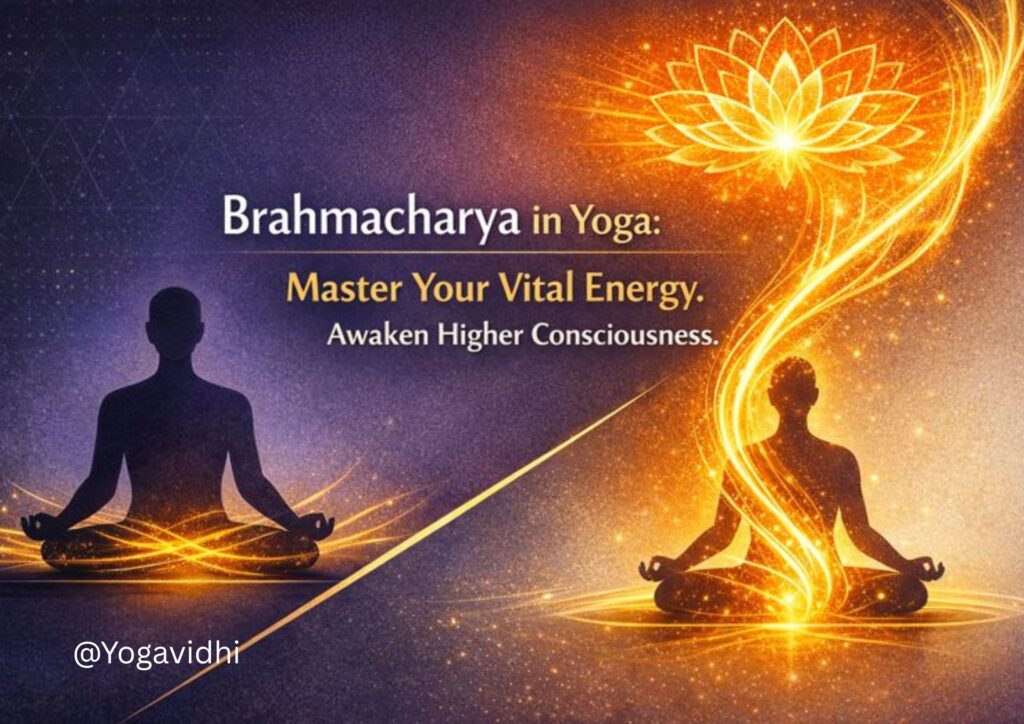
Brahmacharya and the Five Yamas
Brahmacharya works in harmony with:
- Ahimsa, non-violence
- Satya, truthfulness
- Asteya, non-stealing
- Aparigraha, non-attachment
Together, they create ethical integrity and spiritual alignment.
Conclusion: Brahmacharya as Conscious Living
Brahmacharya in yoga is not about renunciation. It is about refinement. It teaches us to live deliberately, love consciously, and act with awareness. In a world that constantly pulls our attention outward, Brahmacharya gently guides us back to ourselves.
When energy is respected, life becomes balanced. When desire is understood, freedom emerges. Brahmacharya is not restriction. It is liberation through awareness.
FAQ:
Q. What does Brahmacharya in yoga really mean?
Ans: Brahmacharya in yoga means practicing moderation and conscious use of energy in thoughts, actions, and lifestyle. While it is often misunderstood as celibacy, its deeper meaning is self-restraint, balance, and mindful living. Brahmacharya encourages directing physical, mental, and emotional energy toward personal growth, inner clarity, and spiritual awareness rather than excess or indulgence.
Q. Is Brahmacharya in yoga only about sexual restraint?
Ans: No, Brahmacharya in yoga is not limited to sexual restraint. It applies to all forms of excess, including overeating, overworking, emotional dependency, and digital overuse. Sexual discipline is only one aspect. The broader goal of Brahmacharya is to prevent energy drain and promote harmony in every area of life.
Q. Can householders and married people practice Brahmacharya in yoga?
Ans: Yes, householders and married individuals can fully practice Brahmacharya in yoga. For them, it means conscious relationships, emotional responsibility, and moderation rather than complete celibacy. Yoga teaches balance, not denial, allowing people to live engaged lives while maintaining self-awareness and inner discipline.
Q. What are the benefits of practicing Brahmacharya in yoga?
Ans: Practicing Brahmacharya in yoga leads to increased vitality, improved mental focus, emotional stability, stronger willpower, and deeper meditation. By conserving and channeling energy wisely, practitioners experience reduced anxiety, better self-control, and a greater sense of inner peace and purpose.
Q. How can beginners start practicing Brahmacharya in yoga?
Ans: Beginners can start practicing Brahmacharya in yoga by becoming aware of habits that drain energy. Simple steps include mindful eating, limiting digital distractions, practicing moderation in relationships, and observing thoughts without impulsive reaction. Supporting practices such as pranayama, meditation, and self-reflection help cultivate Brahmacharya naturally over time.
Q. What is the meaning of brahmacharya in yoga?
Ans: In yoga, Brahmacharya goes far beyond the idea of celibacy. It refers to right conduct or “moving toward the Divine,” emphasizing the mindful conservation and conscious direction of one’s physical, mental, and emotional energy toward spiritual growth, rather than merely abstaining from sexual activity. It involves self-discipline, mastery over the senses, and purity in thought, speech, and action, so that sensory experiences are refined and ultimately oriented toward higher consciousness and the Supreme Reality, Brahma.
Q. What are the 8 rules of brahmacharya?
Ans: The eight rules of Brahmacharya, also known as the “eight breaks” or “eight enjoyments,” emphasize regulating the senses and restraining lustful thoughts toward the opposite sex. They include seeing (Darshan/Prekshanam), touching (Sparshan/Keli), speaking (Kirtan/Guhya-bhashan), forming intentions or resolutions (Sankalpa/Adhyavasaya), and engaging in the sexual act itself (Kriya-nivrutti). Together, these principles aim to preserve purity, strengthen mental focus, and support spiritual discipline by preventing lustful tendencies in thought, speech, and action.
Q. Which yoga is best for brahmacharya?
Ans: Yoga Poses and Practices for Brahmacharya
1. Anjaneyasana (Low Lunge Pose)
2. Parivrtta Anjaneyasana (Revolved or Twisting Low Lunge)
3. Ashta Chandrasana (Crescent Moon Pose)
4. Virabhadrasana III (Warrior III Pose)
5. Balasana (Child’s Pose)
6. Kapalabhati Pranayama (Skull-Shining Breathing Technique)
7. Prana Mudra
8. Chanting of the mantra Om Somaye Namaha
Declaration Note:
We use third-party videos and images on https://yogavidhi.com/ for educational and illustrative purposes. All rights belong to their respective owners. No copyright infringement is intended.